Water just hit your Bellevue home — dishwasher leak, refrigerator water line, washing machine failure, or burst pipe through hardwood-floored rooms. The next question every King County homeowner asks: can these floors be dried and refinished, or do they all need to come up?
This guide walks through the repair vs replace decision tree for water-damaged hardwood floors in Pacific Northwest climate — the drying window, the cupping versus crowning tests pros use, and the Puget Sound humidity factors that complicate the call.
Key Takeaways
- ›Solid hardwood caught within 24-48 hours often dries and refinishes successfully.
- Engineered hardwood with delaminated veneer or warped substrate almost always requires replacement.
- Pacific Northwest humidity (60-80%) extends drying timelines significantly versus dry-climate markets.
Solid vs Engineered: It Matters
Solid hardwood (3/4 inch thick boards of single-species wood) tolerates moisture better than engineered hardwood (multi-layer construction with thin veneer over plywood core). Solid hardwood that’s cupped from moisture can often dry and be re-sanded flat. Engineered hardwood that’s delaminated or whose substrate has swelled cannot be returned to original condition — replacement is the only option.
When You Can Dry and Restore
- Solid hardwood (not engineered)
- Water exposure caught within 24-48 hours
- Cupping is minor (less than 1/32 inch height differential between boards)
- No crowning visible
- Boards still tightly fitted (no significant gaps developing)
- Subfloor moisture content acceptable (under 14% by meter reading)
- Source of water identified, stopped, and was clean (Cat 1)
When Replacement Is the Right Call
- Engineered hardwood with any visible delamination or warping
- Crowning visible (boards bowing up in middle — usually irreversible)
- Severe cupping (boards visibly raised at edges, gapping between boards)
- Subfloor moisture readings above 16-18%
- Cat 2 (gray water) or Cat 3 (sewage) water source
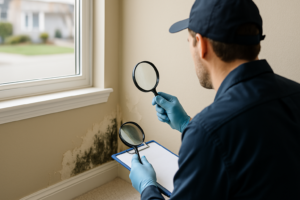
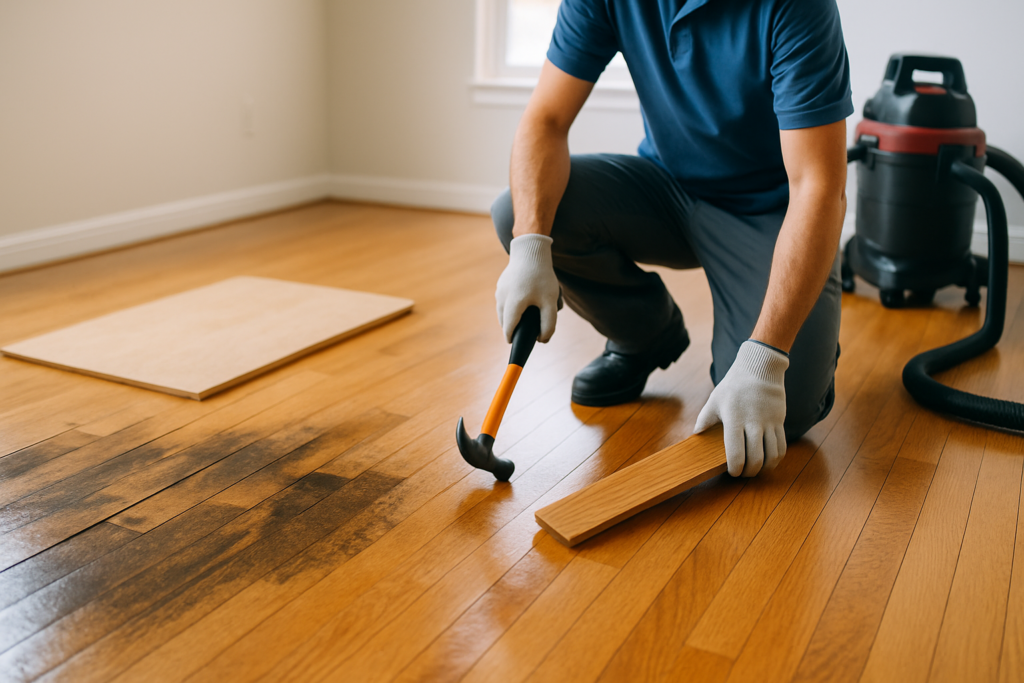
- Mold visible at edges or underneath boards (lift one to check)
- Boards have been wet repeatedly (multiple events)
Cupping vs Crowning: The Critical Distinction
Cupping
Cupping is when board edges raise higher than the center, creating a concave U-shape across each board. This happens when moisture saturates the bottom of the board (from subfloor or seepage) and the bottom expands faster than the top. Cupping is the first stage of moisture damage and is often reversible with proper drying — boards return to flat as moisture equalizes through the board.
Crowning
Crowning is when board centers rise higher than edges, creating a convex hump. This usually happens when cupped floors are sanded flat before they fully dried — the bottom remains wet, the top is sanded down, and as the bottom dries, the center rises above the edges. Crowning is almost always irreversible and requires full replacement of affected boards.
The Drying Process for Salvageable Hardwood
Step 1: Source Control and Extraction
Stop the water source. Extract standing water immediately. Every minute water sits on hardwood, more moisture penetrates the wood and the subfloor below.
Step 2: Hardwood Drying Mats
Professional drying uses panel-style mats laid over the affected hardwood with high-velocity air flow underneath. This pulls moisture from the bottom of the wood (where it’s hardest to remove with surface fans) and creates the drying gradient needed to reverse cupping.
Step 3: Dehumidification
Commercial dehumidifiers (90-150 pint) maintain low ambient humidity to support the drying process. In Bellevue’s Pacific Northwest humidity, this matters more than in dry climates — without dehumidification, water moves from wood into air and then back into wood as humidity equalizes.
Step 4: Moisture Monitoring
Pin meter readings track wood moisture content daily. Target: equilibrium moisture content for Pacific Northwest (typically 8-12%). When wood reaches target, drying equipment is removed and the floor is allowed to acclimate for 30-60 days before refinishing decisions are made.
Step 5: Refinishing (After Acclimation)
Once the floor has stabilized at equilibrium moisture content, sanding flat and refinishing restores the appearance. Minor cupping (under 1/32 inch) sands out easily; moderate cupping (1/32 to 1/16 inch) requires more aggressive sanding which reduces the floor’s remaining lifespan.
Pacific Northwest Humidity Considerations
Bellevue and broader Puget Sound climate creates specific hardwood floor challenges. Outdoor humidity averages 60-80% year-round, which means indoor wood floors naturally hold higher moisture content than in arid climates. Drying water-damaged hardwood in Pacific Northwest humidity requires more equipment and longer runtimes — typical mainland drying protocols assume 30-50% humidity that doesn’t apply here. After successful drying, maintaining indoor humidity between 35-55% with HVAC and dehumidification prevents future moisture issues.
Cost Comparison: Dry-and-Restore vs Replace
- Hardwood drying with panel mats: $800-$2,500 depending on affected area
- Sanding and refinishing after successful drying: $4-$10 per sqft ($1,000-$3,000 for typical room)
- Partial hardwood replacement (lacing in new boards): $12-$25 per sqft installed
- Full hardwood replacement matching existing: $8-$18 per sqft for material, $4-$8 per sqft for installation
- Engineered hardwood replacement: $6-$15 per sqft material + installation
**How long can hardwood floors stay wet before they need to be replaced?**
Solid hardwood: 24-48 hours of moisture exposure is typically the salvageable window. Engineered hardwood: often 12-24 hours, less if veneer delaminates immediately. After these windows, structural damage to the wood (or substrate for engineered) usually requires replacement. Pacific Northwest humidity may shorten these windows further.
**Can I dry hardwood floors with fans alone in Bellevue?**
Almost never effectively. Consumer fans don’t create the humidity gradient required to dry wood in Pacific Northwest air. You need commercial dehumidifiers plus high-velocity air movers (ideally with hardwood drying mats) sized to the affected square footage. DIY drying with consumer fans usually fails to reach acceptable wood moisture content.
**Will my Bellevue hardwood floors cup permanently after water damage?**
Minor cupping usually resolves with proper drying. Moderate cupping may resolve partially. Severe cupping (boards visibly lifted, significant edge raising) often becomes permanent or develops into crowning. The longer wood stays wet, the more likely cupping becomes permanent.
**Does Washington homeowners insurance cover hardwood floor replacement?**
Sudden internal water damage causing hardwood failure (burst pipe, appliance failure) is typically covered. Gradual leaks may face partial denial. Match policies often require full room replacement when partial replacement would leave visibly mismatched flooring. Document the damage thoroughly and get a professional scope before negotiating with the adjuster.
Got Wet Hardwood Floors in Bellevue?
The dry-versus-replace decision depends on factors you can’t always assess visually — wood moisture content, subfloor condition, cupping severity, and water source classification. Acting quickly (within hours, not days) is the single biggest factor in whether your floors can be saved.
Schedule a hardwood damage assessment with our Hardwood Floor Drying team — panel-mat drying equipment, moisture meters, and Pacific Northwest humidity expertise. Direct insurance billing across Bellevue and the broader King County area, IICRC-certified for wood floor restoration.