Your Tacoma home took water — burst pipe in the last cold snap, atmospheric river-driven roof leak, washing machine failure, or hidden plumbing slow leak that finally showed itself. The restoration crew you hire decides whether the work is properly documented for your insurance claim or becomes a fight over scope.
This guide walks through how to choose a Tacoma water damage restoration company — the 7 questions every Pierce County homeowner should ask, the certifications that matter, and the Puget Sound-area red flags worth knowing.
Key Takeaways
- ›IICRC certification is the only credible industry credential — ask for the technician’s certification number.
- Washington requires contractors to register with L&I — verify before signing anything.
- Local Puget Sound crews understand Pacific Northwest moisture and mold realities better than out-of-state storm chasers.
7 Questions to Ask Before You Hire
1. IICRC Certification Number?
IICRC is the industry’s only credible certification body. Real Tacoma restoration companies provide certification numbers on request — Water Restoration Technician (WRT), Applied Structural Drying (ASD), Applied Microbial Remediation Technician (AMRT). Hesitation on providing numbers means they’re subbing the work to someone else.
2. Washington L&I Registration?
Washington requires contractors to register with the Department of Labor and Industries (L&I). Verify registration at lni.wa.gov — active registration shows bond status, workers’ compensation account status, and any disciplinary history. Unregistered contractors expose you to liability and void most homeowners insurance claims.
3. Physical Tacoma or Puget Sound Office?
After major freeze events and atmospheric river storms, out-of-state restoration crews flood Washington. They take immediate work then disappear before warranty service is needed. Ask for a Pierce County, King County, or Thurston County physical address with 253, 206, 425, or 360 phone numbers. Drive past if possible — real local presence means accountability.
4. Direct Insurance Billing?
Real restoration companies bill insurance directly. You should NOT need to pay cash upfront for a covered loss. Some firms ask for your deductible at start of work — that’s standard. Avoid Assignment of Benefits (AOB) contracts that sign away your claim rights to the contractor.
5. What Equipment Do You Bring On Site?
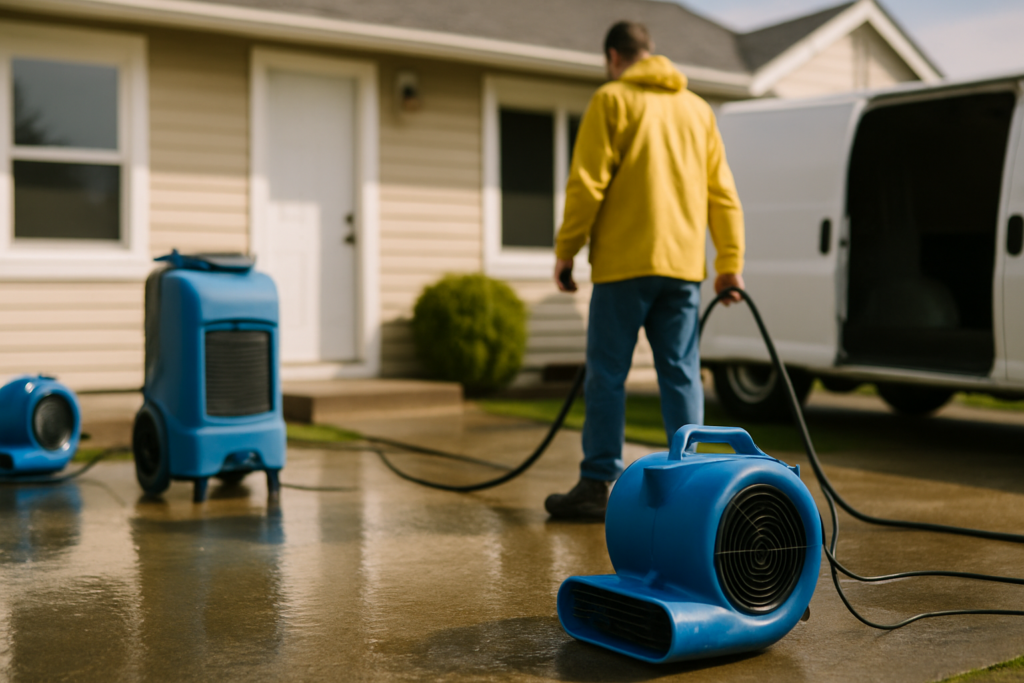
Real drying requires commercial-grade equipment: 90-150 pint dehumidifiers, 6-12 high-velocity air movers per residential job, moisture meters, thermal imaging cameras, and HEPA air scrubbers for mold or smoke jobs. Pacific Northwest humidity (60-80% year-round in many seasons) means equipment count and runtime matters more here than in dry climates.
6. Recent Local References?
Ask for three Tacoma, Puyallup, Federal Way, or Pierce County jobs completed in the last 90 days. Real local crews provide them on the spot. Call at least one. Ask about: communication during the job, documentation provided, insurance billing experience, and any post-completion mold or moisture issues.
7. What’s Your Documentation Process?
Ask how the crew captures the loss for your insurance claim: timestamped photos, daily moisture readings, equipment placement records, written scope. Real crews do this as SOP because adjusters scrutinize the documentation. Companies that ‘don’t worry about that paperwork’ leave you fighting your adjuster alone.
Red Flags to Walk Away From
- Door-to-door solicitation after freeze events, atmospheric river storms, or flooding
- Pressure to sign Assignment of Benefits (AOB) on the spot
- Cash-only or large upfront cash demands beyond the deductible
- No physical local address; out-of-state phone numbers on trucks
- Vague warranty terms, refusal to provide IICRC numbers or L&I registration
- Quotes dramatically lower than competitors — usually corners getting cut on equipment, drying time, or antimicrobial treatment
Pacific Northwest Specifics That Matter
Tacoma and broader Puget Sound have water damage patterns specific to the region. Atmospheric river events (October-March) drive roof leaks and basement flooding from sustained heavy rain. January and February cold snaps cause burst pipe spikes in homes with marginal insulation in crawl spaces, exterior walls, and unconditioned garages. Pacific Northwest humidity routinely runs 60-80% year-round, which means drying takes longer and equipment sizing matters more than in dry-climate markets. Mold establishes quickly in coastal Washington — within 24-48 hours of moisture exposure — so timing and equipment matter more here than in arid regions.
**How do I verify a Washington restoration contractor?**
Visit lni.wa.gov and use the contractor lookup tool. Search by name or registration number. Active registrations show bond status, workers’ compensation account, and any disciplinary history. Combine this with IICRC certification verification at iicrc.org and current proof of insurance from the carrier.
**Should I get multiple quotes for water damage in Tacoma?**
For emergency mitigation (active water, recent damage) — call your top choice immediately to start drying, then get comparison quotes for reconstruction. For non-emergency loss (slow leak repair, mold remediation) — get 2-3 written quotes. Insurance-paid mitigation typically doesn’t require multiple quotes if scope is reasonable.
**How long does water damage restoration take in Tacoma?**
Initial mitigation and drying setup: same day for emergency response. Active drying: 4-7 days for typical residential losses in Pacific Northwest humidity (longer than dry-climate markets). Reconstruction: 1-3 weeks depending on scope. Atmospheric river events with widespread flooding extend timelines.
**Does Washington homeowners insurance cover water damage?**
Sudden internal water damage (burst pipe, appliance failure, sudden plumbing break) is typically covered. Gradual leaks may face partial denial — adjusters distinguish ‘sudden and accidental’ from ‘long-term neglect.’ Flood damage from rising water (atmospheric river overflow, river flooding) requires separate FEMA flood insurance.
Need a Tacoma Crew On Site Today?
Water damage in Pacific Northwest homes can establish mold faster than dry-climate markets. Every day undiagnosed, the underlying problem spreads and the insurance scope gets harder to negotiate.
Our Water Damage Restoration in Tacoma, WA crew responds across Pierce County and the broader Puget Sound region within 60-90 minutes — IICRC-certified, L&I-registered, and equipped for Pacific Northwest moisture conditions. Direct insurance billing on most major Washington carriers.