Water Heater Leak Cleanup Seattle: What Happens After the Tank Fails
A fifty-gallon water heater sitting in a utility closet or basement corner doesn’t look like much of a threat — until the tank fails. When it does, it can discharge its entire contents onto your floor in minutes, and in older Seattle-area homes where water heaters often sit directly above finished basements or hardwood flooring, that water moves fast and far. The water damage left behind is a restoration problem, and those are two very different conversations.
This guide covers exactly what happens during professional water heater leak cleanup in Seattle: what gets extracted, what gets dried, where mold risk hides, and why the cleanup process matters as much as getting the new tank installed.
Replacing the failed water heater stops the source. It does not dry your subfloor, your wall cavity, or your insulation. Water that isn’t extracted and dried promptly creates secondary damage that costs significantly more to fix — including mold remediation.
Emergency Water Extraction After a Water Heater Leak
How Water Heater Leaks Spread Damage Fast in Seattle Homes
Water heater failures aren’t always dramatic. Sometimes a pressure relief valve weeps for days before anyone notices. Sometimes a corroded fitting drips slowly into a wall cavity. And sometimes — especially with older tank-style units — the bottom simply rusts out and the full tank volume hits the floor at once.
In Seattle and the surrounding Puget Sound region, older housing stock means older plumbing, older water heaters, and floors that have already absorbed years of Pacific Northwest moisture. When a tank fails in that environment, water doesn’t just sit on the surface. It seeps into:
- Subfloor sheathing — plywood and OSB absorb water quickly and begin to swell and delaminate
- Wall framing and drywall — especially when a heater sits in a closet or alcove with drywall on three sides
- Insulation batts — fiberglass and cellulose insulation hold moisture and become a mold substrate
- Hardwood and engineered flooring — cupping and buckling begin within hours of saturation
- Finished basement ceilings — if the heater is on the main floor, water migrates down through floor assemblies
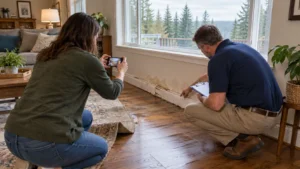
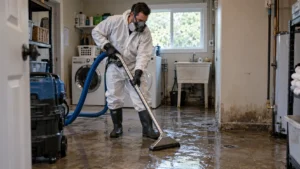
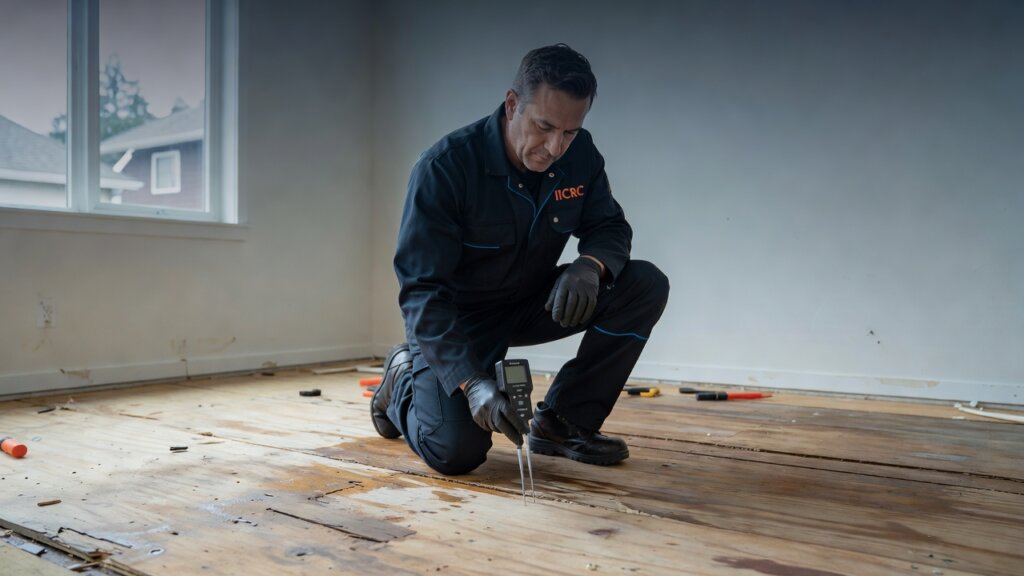
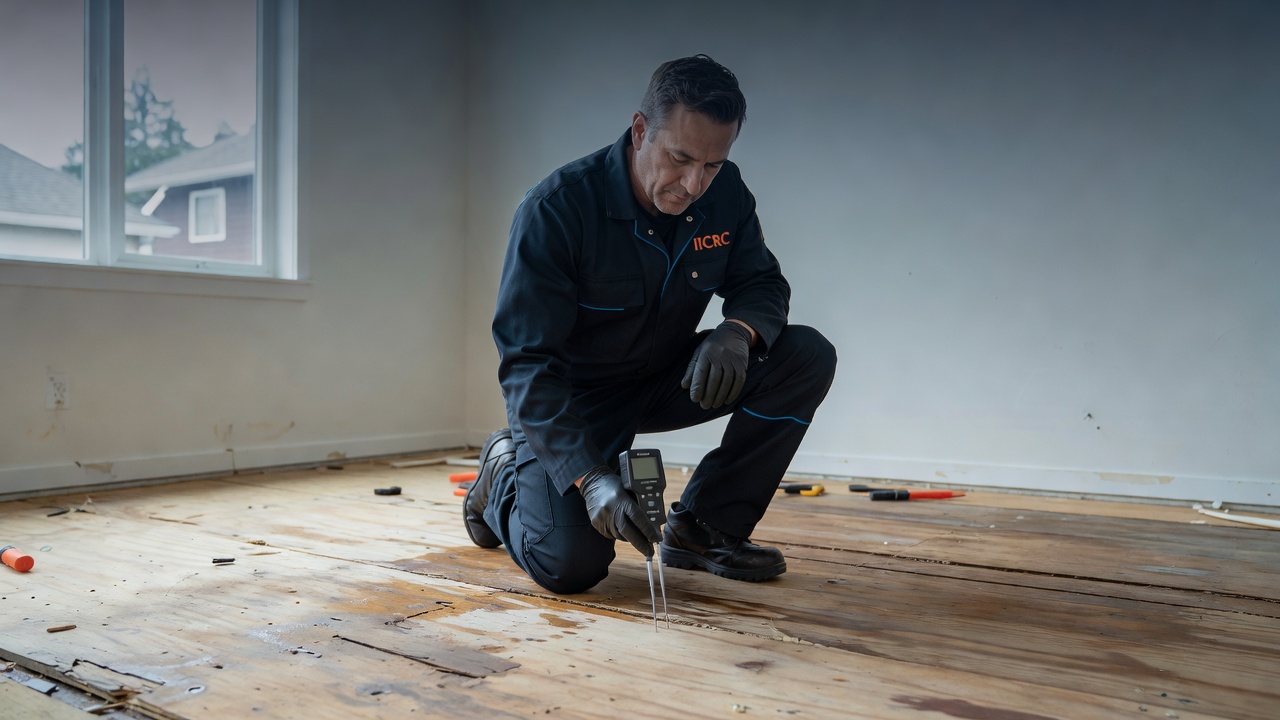
The extraction step is about removing standing and absorbed water before it migrates further. IICRC-certified technicians use truck-mounted and portable extraction equipment to pull water from both hard surfaces and carpet, then deploy moisture meters and thermal imaging to find water that has already moved into hidden cavities.
Why Timing Is the Most Important Variable
Water damage follows a predictable progression. In the first hour, water spreads across surfaces. As time passes, it wicks into drywall and framing. Once moisture reaches organic materials and stays there, mold spores already present in the environment can begin to colonize. Materials that could have been dried in place early in the process may require removal if drying is delayed.
That progression is why Premier Water Removal targets a roughly 60-minute on-site response for water emergencies across the Seattle metro, King County, and Pierce County. The faster extraction begins, the more material can be saved — and the lower the total restoration cost.
“The water heater gets replaced in an afternoon. The water damage it left behind can take days to dry properly — and weeks to become a mold problem if it isn’t dried at all.”
Water Heater Leak Damage: What Gets Affected and Why It Matters
Structural Drying After a Water Heater Failure
Structural drying is the controlled process of removing moisture from building materials — framing, subfloor, drywall, concrete — using calibrated drying equipment rather than just airflow. It’s distinct from simply running fans and hoping for the best.
After a water heater leak, IICRC-certified technicians establish a drying system that typically includes:
- Industrial air movers positioned to create directed airflow across wet surfaces and into wall cavities
- Commercial dehumidifiers to pull evaporated moisture out of the air before it re-deposits on cooler surfaces
- Drying mats or injectidry systems for hardwood floors and subfloor assemblies that can’t be reached by surface airflow alone
- Moisture monitoring with daily psychrometric readings to confirm drying is progressing and document the process for insurance
The goal isn’t just dry-to-the-touch. It’s dry-to-industry-standard — moisture content readings that fall within the IICRC S500 guidelines for the specific material being dried. Subfloor plywood, drywall, and hardwood each have different acceptable moisture thresholds, and hitting those numbers is what prevents secondary damage.
Hardwood and Carpet Drying Specific to Water Heater Leaks
Water heaters are frequently installed in utility areas adjacent to finished living space. In Seattle homes, that often means hardwood floors in adjacent hallways or kitchens are the first finished surface affected when a tank fails.
Hardwood is unforgiving. Once it cups or buckles, it may not flatten even after drying — the window for saving hardwood floors is narrow, and it closes faster than most homeowners expect. Drying mats placed directly on the floor surface pull moisture from below the wood through the subfloor, which is the only way to dry the assembly without demolition.
Carpet and pad in adjacent rooms present a different challenge. Carpet can often be extracted and dried in place if the pad hasn’t fully saturated. Once the pad is soaked, it typically needs to come out — it holds water like a sponge and dries too slowly to prevent mold growth underneath.
Basement and Crawl Space Drying After an Upstairs Heater Leak
Many Seattle and Bellevue homes have water heaters on the main floor directly above a basement or crawl space. When a tank fails, water follows gravity through floor penetrations, electrical conduit paths, and gaps in the subfloor assembly.
Crawl spaces are particularly vulnerable. The combination of limited airflow, soil moisture already present in the Pacific Northwest climate, and sudden water intrusion from above creates ideal conditions for mold and wood rot. Crawl space drying after a water heater leak requires dedicated equipment — desiccant dehumidifiers, crawl space air movers, and in some cases temporary encapsulation to isolate the drying zone.
Premier Water Removal’s technicians assess both the visible damage area and the floor assembly below it as part of every water heater leak response. If water has migrated to the basement or crawl space, that scope is documented and addressed in the same service call.
A water heater leak on the main floor is frequently a basement or crawl space problem too. Moisture follows gravity and building penetrations. Any restoration scope that only addresses the visible surface area is incomplete.
Mold Risk From Water Heater Leaks in the Pacific Northwest
Why Seattle Homes Are Especially Vulnerable
Mold risk after a water heater leak isn’t theoretical — it’s a direct function of how much moisture remains in building materials and how long it stays there. In the Pacific Northwest, ambient humidity is already elevated for much of the year. Seattle’s wet winters and mild summers mean that building materials in older homes often carry baseline moisture levels close to the threshold where mold growth becomes possible.
Add a water heater failure to that baseline, and the conditions for mold colonization are present almost immediately. Mold doesn’t need standing water. It needs moisture content in organic materials — drywall paper, wood framing, insulation — above a certain threshold, combined with moderate temperatures. Both conditions exist in most Seattle homes after a tank failure.
What Mold Remediation Looks Like After an Appliance Leak
Mold remediation after a water heater leak is typically more contained than remediation after a flood or sewage backup, because the water source is clean (Category 1 water, in IICRC terminology). But contained doesn’t mean simple.
If drying was delayed — or if the leak went undetected for days — mold growth can establish in wall cavities, behind baseboards, and under flooring before any visible signs appear on the surface. By the time you see discoloration on drywall or smell the characteristic musty odor, the colony is already established.
Professional mold remediation in this scenario typically involves:
- Moisture mapping to identify all affected materials
- Containment of the work area to prevent spore dispersal during removal
- Removal of materials that cannot be dried to standard (saturated drywall, wet insulation)
- HEPA vacuuming and antimicrobial treatment of affected framing
- Clearance verification before reconstruction begins
Premier Water Removal handles mold remediation as a core service — not as a referral to a separate contractor. That matters for insurance claims, because a single scope of work with documented moisture readings from start to finish is easier to process than two separate contractor invoices.
How Fast Action Helps Prevent Costly Water Damage
The Restoration Window Is Real
But the restoration window — the period during which professional drying can save materials that would otherwise require removal and replacement — closes fast.
They work in parallel, not in sequence. The restoration crew handles everything the tank left behind.
What Delays in Cleanup Actually Cost
Every additional day of unaddressed moisture in a structure increases the scope of work required. Drywall that could have been dried in place early on may require full removal after extended delay. Subfloor sheathing that was saveable on day one may be delaminating by day three. Mold remediation that wasn’t needed at all becomes necessary after a week of unaddressed moisture.
Those scope increases translate directly to higher claims costs and longer displacement from the affected area. Professional water extraction and structural drying, started quickly, consistently reduces total restoration cost.
Water Heater Repair & Installation Services in Seattle
When a water heater fails, two things need to happen: the damaged unit must be replaced, and the water it left behind must be properly remediated. Coordinating both trades promptly is the fastest path to a fully restored home.
Insurance and Water Heater Leak Cleanup in Seattle
What Homeowners Insurance Typically Covers
Most standard homeowners insurance policies in Washington State cover sudden and accidental water damage from appliance failures — including water heater leaks. The key word is sudden. A slow leak that went undetected for months may be treated differently than a catastrophic tank failure that happened overnight.
Coverage typically includes water extraction, structural drying, demolition of unsalvageable materials, and mold remediation if mold resulted from the covered event. It does not typically cover the water heater itself (that’s a separate appliance coverage question) or pre-existing damage.
Working Directly With Your Insurance Carrier
Premier Water Removal works directly with major insurance carriers and provides full claims assistance — including detailed moisture documentation, psychrometric drying logs, and itemized scope of work that adjusters require to process a claim. As a preferred vendor for insurers, the team understands what documentation is needed and provides it as a standard part of the restoration process.
For homeowners in Auburn, Seattle, Bellevue, Tacoma, and across King and Pierce counties, that direct billing relationship means less paperwork on your end during an already stressful situation.
Premier Water Removal handles direct insurance billing and full claims documentation as a standard part of every water heater leak cleanup — not an add-on. Bring your claim number when you call, and the team takes it from there.
Why Choose Premier Water Removal for Water Heater Leak Cleanup in Seattle
IICRC-Certified Technicians Serving the Puget Sound Since 1998
Premier Water Removal is a family-owned, locally operated restoration company led by Monique Fell, serving the greater Seattle and Puget Sound region since 1998. IICRC certification means technicians follow the industry’s established standards for water damage mitigation and drying — not a proprietary process, but the same standards that insurance adjusters and building inspectors recognize.
The team is also BBB Accredited and Google Guaranteed, with a 4.4-star rating across 105 reviews on platforms including Google, Yelp, and Facebook. Those reviews reflect real homeowners and property managers across King, Pierce, Kitsap, Mason, and Thurston counties who needed emergency restoration and got it.
A Real Job: Auburn Water Heater Leak Response
A homeowner in Auburn contacted Premier Water Removal after discovering their basement utility room had flooded overnight from a failed tank-style water heater. By the time the call came in, water had already migrated under an adjacent hardwood hallway and into the base of two drywall partitions. Premier’s technicians arrived on-site, performed a full moisture assessment using thermal imaging and pin meters, and confirmed saturation in both the subfloor assembly and the lower six inches of drywall on three walls. Extraction and drying equipment were deployed the same visit. Daily psychrometric monitoring confirmed the subfloor and framing reached acceptable moisture thresholds within the drying period, and the hardwood floor was saved without demolition. The completed moisture log was submitted directly to the homeowner’s insurance carrier as part of the claim documentation.
Free Moisture Analysis and 24/7 Emergency Dispatch
Every water heater leak response includes a free moisture analysis — not an estimate based on what’s visible, but an actual assessment using moisture meters and thermal imaging to find water that has already migrated beyond the obvious damage area. That analysis drives the restoration scope, which means nothing gets missed and nothing gets over-scoped.
Emergency dispatch is available 24 hours a day, seven days a week, with a roughly 60-minute on-site response target across the Seattle metro. Water heaters don’t fail on a schedule. Neither does Premier Water Removal’s availability.
Serving Auburn, Seattle, Bellevue, Tacoma, and the Greater Puget Sound
Premier Water Removal’s service area covers the full Puget Sound region — Auburn, Seattle, Bellevue, Tacoma, Olympia, Lakewood, Covington, Kent, Renton, Federal Way, Puyallup, Kirkland, Redmond, Bothell, and Burien. If you’re in King, Pierce, Kitsap, Mason, or Thurston County and a water heater has failed, the team can be on-site fast.
Frequently Asked Questions About Water Heater Leak Cleanup
Can I dry out a water heater leak myself?
Surface water can be mopped up, but the moisture that has wicked into subfloor, drywall, and wall framing cannot be adequately addressed with household fans and towels. Without moisture meters, you have no way to confirm that materials have dried to a safe threshold. Incomplete drying is the primary cause of mold growth after appliance leaks.
How long does water heater leak cleanup take?
Extraction typically takes a few hours. Structural drying takes longer — the IICRC S500 standard calls for drying to be complete when materials reach their acceptable moisture content. The duration depends on the extent of saturation and the materials involved. Daily monitoring confirms progress.
Does a water heater leak always cause mold?
Not if cleanup begins quickly. Mold requires sustained moisture in organic materials. Professional extraction and structural drying that begins promptly reduces mold risk. Delays — especially in wall cavities or under flooring — substantially increase the likelihood of mold colonization.
What if the water heater leak went undetected for days?
Slow leaks that go undetected are actually more common than catastrophic failures. If a leak has been present for days or longer, mold remediation is likely part of the scope. Premier Water Removal’s free moisture analysis will identify the full extent of moisture migration and mold growth, and the team handles both remediation and drying as a single integrated service.
Related Seattle Plumbing Pages
Water heater leak cleanup is one part of a broader set of water damage scenarios Premier Water Removal responds to across the Seattle metro. Related services and resources for Seattle-area property owners include basement and crawl space drying, sewage backup cleanup, flood damage restoration, and mold remediation following appliance or plumbing failures. Each service follows the same IICRC-certified process: moisture assessment first, extraction and drying second, documentation throughout for insurance. If a plumbing failure has caused water damage in your home — whether from a water heater, a burst pipe, or a backed-up drain — Premier Water Removal’s technicians are dispatched from the same 24/7 emergency line: (253) 400-5633.
Get Water Heater Leak Cleanup Started Now
The water heater is getting replaced. The question is whether the water damage it left behind gets properly addressed before it becomes a mold problem, a structural problem, or a much larger insurance claim. water heater leak cleanup across Seattle, Auburn, Bellevue, Tacoma
If a water heater has failed in your home or commercial property, contact Premier Water Removal now for a free moisture analysis and emergency water extraction. Don’t wait on the drying — the restoration window is real, and it closes fast.
Related pages
Water Heater Leak Cleanup Seattle: What Happens Step by Step
Emergency Dispatch
24/7 availability with a ~60-minute on-site response target across Seattle metro, King County, and Pierce County
Free Moisture Analysis
Technicians use moisture meters and thermal imaging to find water that has migrated into hidden cavities — not just the visible damage area
Emergency Water Extraction
Truck-mounted and portable extraction equipment removes standing and absorbed water from hard surfaces, carpet, subfloor, and wall cavities
Structural Drying System Setup
Industrial air movers, commercial dehumidifiers, drying mats or injectidry systems deployed for subfloor, drywall, hardwood, and crawl spaces
Daily Moisture Monitoring
Psychrometric readings taken daily to confirm drying progress and document to IICRC S500 standards — each material (plywood, drywall, hardwood) has its own acceptable moisture threshold
Mold Remediation (If Needed)
Containment, removal of unsalvageable materials, HEPA vacuuming, antimicrobial treatment of framing, and clearance verification before reconstruction
Insurance Documentation & Direct Billing
Full claims documentation — moisture logs, psychrometric drying records, itemized scope — submitted directly to major carriers as a standard part of service
Water Heater Leak Cleanup Seattle: What Happens Step by Step — The professional restoration process after a water heater tank failure, from emergency dispatch to clearance verification infographic for Premier Water Removal