Water Mitigation vs Water Restoration: A Clear Decision Guide
Your pipe burst at 2 a.m. By morning, water has soaked through the subfloor, wicked up the drywall, and started working on your framing. Two questions hit you fast: What needs to happen right now? And what comes after?
Those two questions map directly to two distinct phases of water damage recovery: mitigation and restoration. Insurance adjusters use these terms constantly. Contractors bill them as separate line items. But most homeowners have never had them explained clearly — until they’re standing in a wet living room at midnight.
This guide breaks both phases down plainly, explains the emergency sequence from first call to final repair, and shows you how the Puget Sound’s wet climate affects every step. Whether you’re dealing with a burst pipe in Auburn, a flooded basement in Seattle, or a slab leak in Bellevue, the process follows the same logic. If you’re already dealing with water damage, call Premier Water Removal now for 24/7 emergency response — our IICRC-certified technicians can typically be on-site within 60 minutes.
Mitigation stops the damage from getting worse. Restoration brings your property back to pre-loss condition. You always need mitigation first — but not every water event requires full structural restoration. Knowing the difference helps you make faster decisions and avoid costly delays.
Water Damage Mitigation Process
Water Remediation vs Restoration: Understanding the Sequence
Water mitigation is the emergency phase. It refers to every action taken immediately after water damage to prevent further loss — stopping the source, extracting standing water, and beginning the drying process before secondary damage sets in. Restoration is what comes after: repairing or replacing structural materials, flooring, drywall, and finishes that were damaged beyond drying alone.
Think of it this way. Mitigation is triage. Restoration is surgery.
The IICRC (Institute of Inspection, Cleaning and Restoration Certification) — the industry’s governing standards body — defines water damage response in phases, with mitigation preceding any reconstruction work. Premier Water Removal’s technicians are IICRC-certified and follow this sequencing on every job, from a minor appliance leak in Covington to a major flood event in Tacoma.
Step 1: Stop the Water Source
Nothing else matters until the water stops entering the structure. That means shutting off the main supply valve for burst pipes, calling the city for a sewer lateral issue, or tarping a compromised roof after storm damage. On a crawl space moisture event, it may mean addressing a failed vapor barrier or a backed-up drain tile system.
In the Pacific Northwest, this step is complicated by the region’s rainfall patterns. Western Washington averages around 38 inches of rain per year in Seattle — and significantly more in elevated areas east of the Sound. Sump pumps that fail during a heavy rain event in November can flood a basement in under an hour. The source isn’t always a single pipe. Sometimes it’s the ground itself.
Step 2: Emergency Water Extraction
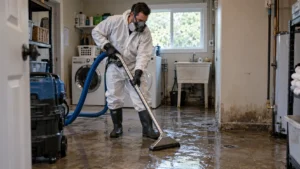
Once the source is controlled, extraction begins. Professional-grade truck-mounted extractors and portable submersible pumps remove standing water far faster than any shop vac or consumer-grade equipment. Speed here is everything — the IICRC’s S500 Standard for Professional Water Damage Restoration notes that mold can begin colonizing porous materials within 24 to 48 hours of saturation under the right humidity and temperature conditions.
The Puget Sound’s ambient humidity — regularly above 70% in fall and winter — accelerates that clock. What might be a 48-hour window in a dry climate can compress significantly in a wet Seattle basement or a poorly ventilated crawl space in Snohomish.
Step 3: Moisture Mapping and Psychrometric Assessment
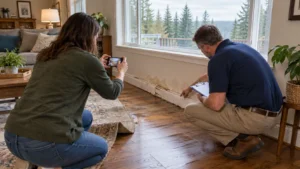
Water travels. It moves through walls, under flooring, into insulation, and along structural members in ways that aren’t visible to the eye. After extraction, Premier’s technicians use thermal imaging cameras, pin-type and pinless moisture meters, and psychrometric calculations to map exactly where moisture has migrated.
This step is what separates professional mitigation from a homeowner with fans running in the living room. A free moisture analysis documents the full scope of saturation before any drying equipment is placed — and that documentation becomes the foundation of your insurance claim.
“Surface-dry is not dry. Water hides inside wall cavities, under hardwood, and in subfloor assemblies for days after the visible puddles are gone. Missing those pockets is how a manageable claim turns into a mold remediation job three weeks later.”
Step 4: Structural Drying and Dehumidification
Drying is not just pointing fans at wet carpet. Proper structural drying uses a calculated placement of industrial air movers, desiccant or refrigerant dehumidifiers, and sometimes injectidry systems that force dry air directly into wall cavities. The goal is to bring all affected materials to their equilibrium moisture content — the point at which further microbial growth is halted.
Drying typically runs three to five days for a Category 1 (clean water) event. Category 2 (gray water from appliances or toilet overflow) and Category 3 (black water from sewage or flooding) events require additional sanitization protocols alongside the drying process. Premier’s team monitors psychrometric readings daily and adjusts equipment placement until all readings confirm the structure is dry.
Mitigation is billable work. Your insurance carrier expects a documented drying log with daily moisture readings. If a contractor can’t provide that log, the claim may be disputed. Premier Water Removal provides full psychrometric documentation as a standard part of every job.
Emergency Water Mitigation
Why Response Time Changes Everything in the Puget Sound
Emergency water mitigation refers specifically to the first-response phase — the hours immediately following a water loss event. How fast a crew arrives directly determines how much of the structure can be saved versus replaced.
Premier Water Removal has operated across King, Pierce, Kitsap, Mason, and Thurston counties since 1998 — more than 28 years serving Puget Sound homeowners and property managers. The team maintains a 24/7 dispatch with a target on-site response of approximately 60 minutes. That response window matters because the Pacific Northwest’s climate doesn’t give you buffer time. A flooded basement in Federal Way during a November rain event isn’t just dealing with the water inside — it’s dealing with 80% outdoor humidity that slows evaporation and feeds secondary moisture problems in adjacent materials.
The practical difference between a 60-minute response and a four-hour response can be the difference between saving hardwood floors and replacing them.
What Emergency Mitigation Covers
- 24/7 dispatch and on-site response — crews mobilized regardless of time or day
- Standing water extraction using truck-mounted and portable units
- Sewage cleanup and contamination control for Category 2 and 3 losses
- Roof tarping and board-up when storm damage exposes the structure
- Basement and crawl space pumping after sump pump failure or groundwater intrusion
- Content protection and pack-out coordination to remove salvageable belongings before further damage
- Initial documentation for insurance claims, including photos, moisture readings, and scope notes
When Mitigation Alone Is Enough
Not every water event requires full restoration. A small appliance leak caught within a few hours — say, a refrigerator supply line that dripped overnight onto a tile floor — may require only extraction, drying, and documentation. If no structural materials absorbed significant moisture and no secondary damage occurred, mitigation closes the job.
This is where an honest assessment from a certified technician matters. Some contractors have a financial incentive to recommend full restoration on every job. Premier’s IICRC-certified team performs the moisture analysis first and scopes only what the readings support. Not sure what your situation requires? Schedule a free moisture assessment with Premier Water Removal — we’ll give you a straight answer backed by documented readings, not guesswork.
Water Extraction and Drying
The Equipment Behind Professional Results
Water extraction and drying is the technical core of the mitigation phase. The equipment used — and how it’s deployed — determines whether a structure dries completely or retains hidden moisture that causes problems months later.
Professional water extraction uses truck-mounted vacuum systems that generate significantly more suction than portable units, pulling water out of carpet, pad, and subfloor assemblies in a single pass. For hardwood floors, specialized floor mat systems apply controlled negative pressure to draw moisture out of the wood without the buckling or cupping that comes from surface-only drying.
After extraction, air mover placement follows a calculated formula based on the square footage of the affected area, the number of wet surfaces, and the ambient conditions. Dehumidifiers are sized to the moisture load — not just plugged in and left running. Daily psychrometric readings track grain depression (the amount of moisture being removed from the air) and confirm the drying system is performing correctly.
| Equipment Type | Purpose | Used In |
|---|---|---|
| Truck-mounted extractor | High-volume standing water removal | Flooded basements, large-area events |
| Submersible pump | Deep standing water in confined spaces | Crawl spaces, utility rooms |
| Industrial air mover | Accelerate surface and structural evaporation | All drying phases |
| Refrigerant dehumidifier | Remove airborne moisture in warm conditions | Living spaces, summer events |
| Desiccant dehumidifier | Remove airborne moisture in cold/low-humidity conditions | Crawl spaces, winter events in the PNW |
| Injectidry system | Force dry air into wall cavities without demolition | Wet walls, closed cavities |
| Thermal imaging camera | Detect hidden moisture migration | Moisture mapping phase |
Hardwood, Carpet, and Structural Materials: Different Rules
Not all materials dry the same way. Carpet and pad can often be extracted and dried in place if the event is Category 1 and response is fast. Hardwood floors are more complex — they absorb moisture through the tongue-and-groove joints and can buckle within 24 hours. Engineered hardwood behaves differently from solid hardwood, and both behave differently from LVP or tile.
Structural materials — framing, OSB sheathing, concrete block — hold moisture longer than finish materials and require extended drying cycles. In the Pacific Northwest, where ambient outdoor humidity stays elevated through the fall and winter months, drying times for structural assemblies often run longer than they would in a drier climate.
Water Damage Restoration Process
From Dry Structure to Finished Space
The water damage restoration process begins only after the structure has been fully dried and documented as dry. Restoration is the reconstruction phase: replacing materials that couldn’t be saved, repairing what was structurally compromised, and returning the property to its pre-loss condition.
Restoration work varies enormously by loss scope. A minor event might require only replacing a section of drywall and repainting. A major flooding event might involve removing and replacing flooring throughout multiple rooms, replacing insulation in a crawl space, rebuilding a portion of a wall assembly, and treating for mold that developed during the drying period.
What Restoration Typically Includes
- Drywall removal and replacement — wet drywall cannot be dried in place once paper facing has delaminated
- Flooring replacement — carpet, hardwood, LVP, or tile that absorbed Category 2 or 3 water, or that buckled beyond salvage
- Insulation removal — especially in crawl spaces and exterior walls where batt insulation holds moisture against framing
- Mold remediation — if mold colonization occurred during the loss period, remediation must be completed before any reconstruction begins
- Structural repair — framing, subfloor, or sheathing that was compromised by prolonged saturation
- Painting, trim, and finish work — restoring the visual finish of affected areas
The Insurance Claim Connection
Most water damage events in the Puget Sound are covered under standard homeowner’s insurance policies — subject to the cause of loss. Sudden and accidental events (burst pipes, appliance failures, storm-driven roof leaks) are typically covered. Gradual leaks or deferred maintenance are typically excluded.
Premier Water Removal works directly with major insurance carriers and handles direct billing and full claims assistance. The documentation gathered during mitigation — moisture maps, psychrometric logs, photo evidence, and scope notes — forms the claim package submitted to your adjuster. Having that documentation organized and complete from day one significantly reduces claim disputes and delays.
Water Mitigation vs Water Restoration: Side-by-Side
Still unclear on where one phase ends and the other begins? This comparison covers the most common questions.
| Question | Water Mitigation | Water Restoration |
|---|---|---|
| When does it happen? | Immediately after the loss event | After the structure is confirmed dry |
| What’s the goal? | Stop damage from spreading; extract and dry | Return property to pre-loss condition |
| How long does it take? | Typically 3–7 days for drying | Days to weeks depending on scope |
| Is it always required? | Yes — every water loss event needs mitigation | No — minor events may need only mitigation |
| Who does it? | IICRC-certified water damage technicians | Restoration contractors (often same company) |
| Is it covered by insurance? | Yes, for covered causes of loss | Yes, for covered causes of loss |
| What documents does it produce? | Moisture maps, drying logs, scope notes, photos | Reconstruction scope, material specs, invoices |
Frequently Asked Questions About Water Mitigation vs Restoration
Do I need both mitigation and restoration after a water loss?
You always need mitigation first. Whether you also need restoration depends on how much structural damage occurred. A small, fast-caught leak may close after mitigation alone. A burst pipe that went undetected for several days will almost certainly require restoration work once the structure is dry.
Can I skip mitigation and go straight to repairs?
No. Repairing or replacing materials before the structure is fully dry traps moisture inside wall cavities and under new flooring, which leads to mold growth and structural deterioration. Insurance carriers will also dispute claims where mitigation documentation is absent. Mitigation must come first.
How do I know when mitigation is complete?
Mitigation is complete when all affected materials reach their target moisture content as confirmed by daily psychrometric readings. A certified technician documents the final readings and signs off on the drying log. Premier Water Removal provides this documentation as part of every job — it’s required for insurance claims and protects you if questions arise later.
Does Premier Water Removal handle both phases?
Yes. Premier’s team handles the full scope from emergency response through structural drying and into restoration work. Having one company manage both phases eliminates the handoff gap where moisture problems can go undetected between a mitigation contractor and a separate reconstruction contractor.
What’s the difference between water remediation and restoration?
Water remediation is a broader term that encompasses both mitigation and restoration — the full process of addressing water damage from emergency response through final repairs. Some companies use remediation and restoration interchangeably. In insurance documentation, mitigation and restoration are typically billed as separate line items, which is why understanding the distinction matters when reviewing your claim.
When to Call Premier Water Removal
If you’re reading this after a water event has already happened, the answer is: now. Every hour of delay in the mitigation phase extends drying time, increases the risk of mold, and adds to the scope of restoration work required.
Premier Water Removal has served the greater Seattle and Puget Sound region since 1998 — more than 28 years of water damage mitigation and restoration experience. The team is IICRC-certified, BBB Accredited, and Google Guaranteed, with a 4.4-star rating across 105+ reviews on Google, Yelp, and Facebook. With 24/7 emergency dispatch and a target 60-minute on-site response, Premier’s technicians arrive with the equipment and expertise to begin mitigation immediately — and the documentation systems to support your insurance claim from the first hour on site.
Premier serves homeowners, landlords, property managers, and commercial property owners across Auburn, Seattle, Bellevue, Tacoma, Olympia, Lakewood, Covington, Snohomish, Kent, Renton, Federal Way, Puyallup, Kirkland, Redmond, Bothell, and Burien. Free moisture analysis is available on every job.
Don’t wait to find out whether you need mitigation, restoration, or both. Contact Premier Water Removal now for 24/7 emergency water damage response across King, Pierce, Kitsap, Mason, and Thurston counties — call us today and have a certified technician on-site within the hour. Your peace of mind is one call away.