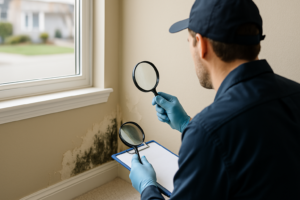

Go and look at your water meter. Note the reading, then use no water at all for two hours, and read it again. If the number moved, something in your house is leaking right now. That two-hour test is free, takes no tools, and is the single most useful thing most homeowners never do.
Key Takeaways
- ›Two free self-tests, the meter check and the toilet dye test, catch most slow leaks before they become damage.
- ›Water damage and freezing is the second most frequent home insurance claim, behind only wind and hail.
- ›The work splits cleanly by season, and almost none of it needs a contractor.
Start With the Two Free Tests
Before buying anything, find out whether you already have a problem. The EPA publishes two checks that cost nothing, and Premier Water Removal runs the same two on arrival.
The Meter Test
Read the meter, avoid all water use for two hours, then read it again. Any movement means a leak somewhere in the system. The EPA flags a second threshold too. A family of four using more than 12,000 gallons in a cold month may have a serious leak.
The Dye Test
Put a few drops of food coloring in the toilet tank and wait ten minutes. Color in the bowl means the flapper is leaking. Flappers wear out and should be replaced at least every five years.
The scale here is larger than most people assume. Household leaks waste close to a trillion gallons a year nationwide. An average household loses over 9,300 gallons annually, and around nine percent of homes leak 50 gallons or more every day.
Winter: The Freeze Window
Auburn does not freeze hard every year, which is exactly the problem. Pipes here are often less protected than in genuinely cold states, so a short cold snap does real damage.
Insulate any supply line in an unheated space. That means the crawl space, the garage and any exterior wall run. Disconnect hoses from outside spigots before the first freeze, because a connected hose traps water in the bib. During a cold snap, open cabinet doors under sinks on exterior walls and let a faucet drip.
Spring: Drainage and Runoff
The wet season is ending but the ground is still saturated. That makes this the right time to look at where water goes.
Clear gutters of fir and cedar debris, then check that downspouts discharge several feet from the foundation. Walk the perimeter and look for soil that has settled back toward the house. Test the sump pump by pouring a bucket into the pit. Confirm it has a battery backup, because the storms that flood a pit also cut power.
Summer: Appliances and Supply Lines
Dry weather is the only comfortable time to crawl behind appliances, so use it.
Check the braided supply lines to the washing machine, dishwasher and icemaker. Rubber hoses should be replaced on a schedule rather than when they burst. Look under every sink with a flashlight for the green or white crust that marks a slow weep. Check the water heater for rust at the base and note its age, because most fail somewhere past the ten-year mark.
Fall: Before the Wet Season Arrives
This is the highest-value month of the year for water damage prevention Auburn WA homeowners can actually act on. Everything gets harder once the rain sets in.
Clear gutters again after leaf drop. Clear yard and area drains. Check crawl space vents and make sure the ground sheeting is intact, because bare soil releases moisture all winter. Confirm the sump pump still cycles. If you have ever had water in the crawl space, this is the month to deal with it.
What It Costs to Skip It
Prevention arguments usually rely on vague urgency. The numbers behind water damage prevention Auburn WA households face are more persuasive.
The Insurance Information Institute reports that about one in 60 insured homes files a water damage or freezing claim each year. Only wind and hail is more frequent, at one in 35. For context, fire and lightning is one in 425.
Average claim severity across all causes reached $20,062 in 2023. The same loss category covers mold damage where a policy includes it. That is why a slow leak behind a cabinet gets expensive quietly.
Frequently Asked Questions
Put It On the Calendar
None of this is difficult work. It fails because it is nobody's job on any particular day. Then a supply line lets go in February. Premier Water Removal sees the result of that every winter. Four reminders a year is the whole system.
If a check turns up something already wet, that is the point to stop guessing. Premier Water Removal is based in Auburn. Our crews bring the metering and water damage restoration that shows how far moisture actually traveled. We work the whole city and the surrounding valley from our Auburn base. A failed pit is usually a sump pump problem worth sorting before the next storm.