Why Does My House Still Smell After Water Damage?
You’ve had the water extracted. The fans ran for days. Everything looks dry. But there’s still a smell, and it isn’t going away. If this sounds familiar, you’re not alone. Persistent odors after water damage, flooding, sewage backups, or fire are one of the most common complaints homeowners in the Greater Seattle area bring to restoration professionals — and one of the most misunderstood.
The short answer is this: if your home still smells, the source of the problem hasn’t been fully addressed. Here’s what’s actually going on and what it takes to fix it.
The Smell Is a Symptom, Not the Problem
A lingering odor is your home telling you something isn’t right beneath the surface. Musty, sour, or smoky smells don’t just appear on their own — they’re produced by an underlying cause, and masking them with air fresheners or candles only delays the inevitable.
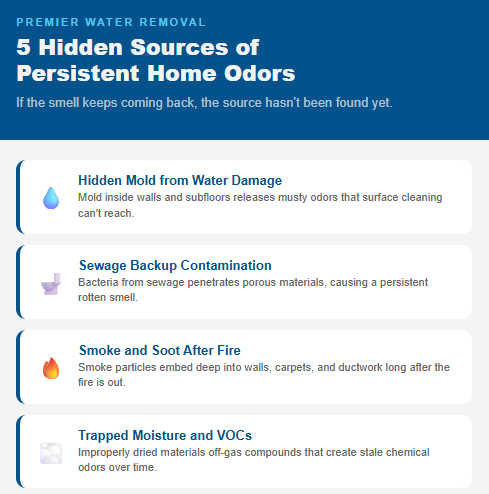
The most common culprits behind persistent household odors after water-related events are mold and mildew growth in walls, subfloors, or ceiling cavities; bacteria left behind from sewage or contaminated floodwater; smoke and soot particles embedded in porous surfaces after fire damage; and moisture trapped in materials that were never fully dried out.
In the Pacific Northwest, where homes regularly contend with heavy rainfall, high humidity, and the occasional flooding event, these issues are particularly common. The region’s climate creates ideal conditions for mold to establish itself quickly and quietly inside wall cavities and crawl spaces.
Why DIY Methods Fall Short
Baking soda, vinegar, store-bought sprays, and plug-in air fresheners are useful for mild, surface-level odors. They are not equipped to handle the kind of deep-seated smells that result from water damage, mold growth, or sewage contamination.
The reason is straightforward: these products treat the air or the surface of a material, not the source of the odor. If mold is growing inside a wall or bacteria has soaked into a subfloor, no amount of spray will reach it. The smell will return, often within days, because nothing has actually changed at the source.
Additionally, attempting to dry out or clean heavily contaminated areas without professional equipment can spread the problem. Disturbing mold colonies without proper containment, for example, releases spores into the air and can carry contamination into other areas of the home.
What Professional Odor Removal Actually Does
Professional odor removal starts by locating the source, not just the smell. Technicians use moisture meters, air quality monitors, and thermal imaging tools to identify hidden mold growth, trapped moisture, and contaminated materials that aren’t visible to the eye.
Once the source is identified, the remediation process begins. Depending on the cause, this may include removing damaged drywall, insulation, or flooring that can’t be salvaged; treating affected structural materials with antimicrobial agents; using ozone generators or hydroxyl machines to neutralize odor compounds at a molecular level; and running industrial-grade dehumidification equipment to eliminate residual moisture that feeds mold and bacterial growth.
The goal isn’t just to make the air smell better temporarily — it’s to eliminate the source entirely so the odor doesn’t return.
Common Scenarios That Require Professional Help
Several situations almost always require professional odor removal rather than DIY approaches. A musty smell that appeared after a flood or pipe burst and won’t go away even after visible drying is nearly always a sign of hidden mold. A sewage or rotten smell following a backup points to bacterial contamination that has penetrated porous materials. A smoky smell that lingers weeks after a fire indicates soot and smoke particles embedded in walls, carpets, and ductwork. A general stale or chemical smell with no obvious cause can indicate mold-related volatile organic compounds or off-gassing from water-damaged building materials.
In all of these cases, the problem is below the surface, and the solution requires professional assessment and equipment.
When to Call a Restoration Company
If you’ve noticed a persistent odor in your home and can’t identify a clear, simple cause, it’s worth having a professional take a look sooner rather than later. Odors that stem from mold or moisture problems tend to get worse over time, not better, as the underlying issue continues to develop.
Premier Water Removal provides professional odor removal services throughout the Greater Seattle area, with 24/7 availability for emergency situations. Our team uses advanced equipment to find the source of the problem and eliminate it completely, not just cover it up.